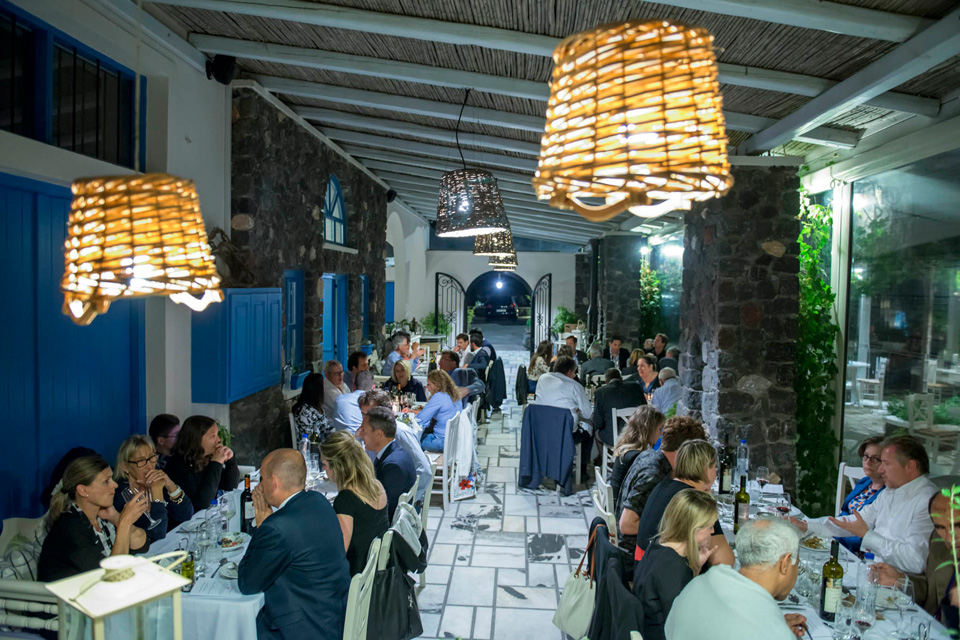
On a recent Saturday evening, wine- loving friends of mine gathered once again to enjoy a lavish - but very healthy and expertly prepared by our hosts! - multi-course dinner paired with a selection of wines from the Eastern Mediterranean judiciously chosen from Greece, Israel and Lebanon. These wine regions have gathered more and more recognition and critical acclaim in recent years and are becoming more available in local wine shops, although they still have a long way to go. (There was a time when the only Greek wine people on this hemisphere knew about was Retsina, that piney white that was to Greece what Mateus was to Portugal - the times, they have a-changed a lot!)
And so, to celebrate these long neglected wine regions, I offer up to you this recap of the wines featured at our dinner in hopes that you will enjoy expanding your palate and virtual wine travels as well!
All these wines were purchased at Wine Works in Cherry Hill, which has a pretty decent selection from these regions.
As for personal preferences, the standouts to me were the Assyrtiko, the Yiron and the Kefraya, although everyone seemed to enjoy all the wines to varying degrees. For rosé fans, the Xinomavro offers a delightful alternative to the ubiquitous Provencal blends with a distinctive flavor profile and vibrant acidity due to this indigendous Greek varietal.
Opa!
And so, to celebrate these long neglected wine regions, I offer up to you this recap of the wines featured at our dinner in hopes that you will enjoy expanding your palate and virtual wine travels as well!
All these wines were purchased at Wine Works in Cherry Hill, which has a pretty decent selection from these regions.
As for personal preferences, the standouts to me were the Assyrtiko, the Yiron and the Kefraya, although everyone seemed to enjoy all the wines to varying degrees. For rosé fans, the Xinomavro offers a delightful alternative to the ubiquitous Provencal blends with a distinctive flavor profile and vibrant acidity due to this indigendous Greek varietal.
Opa!
Tishbi Sauvignon Blanc 2018 www.tishbi.com/en/ $18


Appellation: Shomron, Israel
Varietal: 100% Sauvignon Blanc
Production/Tasting
Notes: more herbaceous than citrusy aromas; a little creamy on the palate; moderate acidity; light bodied.
Food pairing: grilled fish,
Mediterranean dishes
Alcohol: 12.5%
Art. Karamalogos
Assyrtiko 2017 $22


Appellation: Santorini
PDO (Protected Designation of Origin), Greece
Varietal: 100% Assyrtiko
Production/Tasting
Notes: Pneumatic pressing, static
racking; fermentation in thermo-regulated tuns for one to four months. Maturing
for seven months on fine lees;the nose is frank, pleasant, open and racy;
fruity scents: citrus fruit, lemon, floral scents, white flowers, peach, herbal
notes and a fine touch of spice, ginger; opening up to reveal a fine, exotic
character of pineapple and blood orange; creamy texture; bone dry; moderately
rich, dense on the mouth. Long, salty finish.
Food Pairings: prime
grilled fish or shellfish; lamb kebabs; Asian cuisine; grilled chicken; pasta
with aromatic herbs.
Alcohol: 13.5%
Diofili Xinomavro Rosé
2018


Origin: Siatista,
Greece
Varietal: 100% Xinomavro
Production/Tasting
Notes: Dio Fili is located in Siatista, a town located in western Macedonia
just off the Egnantia Odos; 70-115 year old vines; high altitude (900 meters); intense
raspberry, strawberry flavors; melon; vibrant acidity
Food Pairings: fish
with sauce; smoked salmon; duck magret
Alcohol: 12.5%
Mitravelas Estate
Agiorgitiko 2016 $19


Appellation: Nemea
PDO
Varietal: 100% Agiorgritiko
Production/Tasting
Notes: oldest modern winery in Nemea founded in 1913; soil is amixture of clay, limestone and sandy soil; aged for 12
months in new (1/3) and 3year-old (2/3) French oak, followed by 6-12 months in
bottle; unfiltered; dark red fruit with hints of chocolate and spice; soft,
well-integrated tannins.
Alcohol: 14%
Galil Mountain
Yiron 2015 $28


Appellation: Galilee,
Israel
Varietal: 47%
Cabernet Sauvignon; 40% Merlot; 8% Petit Verdot; 5% Cabernet Franc
Production/Tasting
Notes: Aged for 16 months in French oak barrels; complex; elegant; rich
black cherry-berry, plum jam nose; fine notes of dried herbs, vanilla, clove
oak; long finish. (Flagship wine of winery; 91 points, Wine Spectator)
Food Pairings: braised
lamb shoulder, winter squash, and roast turkey.
Alcohol: 15%
Chateau
Kefraya Les Breteches 2016 chateaukefraya.com $12


Origin: Bekaa
Valley, Lebanon
Varietals: 50%
Syrah; 20% Cinsaut; 18% Tempranillo; 7% Cabernet Sauvignon; 5% Marselan
Production/Tasting
Notes: Finely spiced nose of blackcurrant; silky tannins; red fruit flavors
Food Pairing: grilled lamb or chicken skewers
Food Pairing: grilled lamb or chicken skewers
Alcohol: 14%
Notes on Wine Regions and Wineries
Shomron (Samaria) is one of Israel's key wine regions. Although not as famous or prolific as
the Galilee to the north-east, it is home to some of the nation's
most important viticultural heritage. The most obvious with regard to recent
history is Mount Carmel, and the winery named after it. Carmel Winery was
founded in 1882 by Baron Edmond de Rothschild (of the powerful French banking
family that owns Bordeaux Chateaux Lafite and Mouton, among others) and remains
Israel's most prolific wine producer by far.
Shomron is composed of the coastal areas south of the port of Haifa (Israel's third-largest city), the Sharon Plain and Mount Carmel. The climate here is Mediterranean, with warm summers and mild, relatively wet winters. This classic viticultural environment calls to mind the southernmost coastal regions of France, and not just because of the weather and the landscape. The grape varieties of choice here are almost exclusively French, with the likes of Merlot, Cabernet Sauvignon, Semillon, Chenin Blanc and Sauvignon Blanc holding sway.
Israel's New World take on wine, which seems almost ironic given that this area is the very cradle of winemaking, has led the Israeli government to develop its wine tourism interests. It has plans for a national wine center, intended to promote and develop Israel's wine industry worldwide. The proposed site will cover roughly 60 hectares (150 acres) near Binyamina, at the heart of the Shomron region. The Rothschild link appears again here, as the center is to be situated at Binyamina, a town named after Edmond de Rothschild, whose middle name was Benjamin.
The
importance of wine production to the region is reflected in the motto, taken
from Jeremiah 31:5, of Shomron Regional council: "Again You will plant
vineyards on the hills of Samaria".
-Wine-Searcher.com
Galilee is
an administrative and wine region in northern Israel. Its name is perhaps most
widely recognized in the context of Lake Galilee, via its associations with the
Bible, but it is now steadily becoming known as a wine region. 'Water into
wine' is not a new theme for the Galilee region; the story of the wedding at
Cana, in which Jesus turns water into wine, is widely thought to have its
origins here.
The Galilee region is (unofficially) subdivided into Upper Galilee, Lower Galilee and the Golan Heights, with the latter confidently emerging as one the most interesting New World regions of the Old World. Lower Galilee is by far the smallest in terms of area under vine, with just a small viticultural district around Mount Tabor, the iron-rich terra rossa soil of which bears more than a passing resemblance to that of Coonawarra. The vineyards of Upper Galilee and the Golan Heights are considerably more widespread, scattered over almost every part of Israel's north-eastern corner. Thus the soil profiles vary considerably, offering greater choice to contemporary vignerons seeking out their preferred terroirs. Among the soil types in Upper Galilee and the Golan Heights are free-draining gravels such as those found in Graves; limestone, as per the finest terroirs of the Loire Valley and Burgundy; and mineral-rich volcanic basalt, which brings unmistakable richness to such wines as Vesuvio, Etna and Rangen.
The landscape throughout Galilee is characterized by rocky elevations of well over 1500ft (450m), with the topography peaking at Mount Meron (4000ft/1210m) in the far north, near the border with Lebanon. The cool elevations and relatively high rainfall in this area (for what is essentially a semi-desert region) mean that wines made here are atypically fresh and vibrant. Very few wine regions at 33 degrees latitude are capable of producing wine of this quality – those that do are, like Galilee, reliant on high altitude to compensate for their low latitude.
The grape varieties most often used here are of French origin; the Gallic influence is noticeable, but decidedly less overt than it is in neighboring Lebanon. Red wines have traditionally been based on such southern French classics as Carignan, Mourvedre, Grenache and Alicante Bouschet (a deep-hued, Grenache-based crossing) but are almost inevitably moving towards more commercially attractive options including Cabernet Sauvignon, Merlot and Syrah. The whites have followed a similar trajectory, with Semillon, Chenin Blanc and Muscat of Alexandria (the longer-established varieties here) being supplanted by Sauvignon Blanc and Chardonnay. The latter is most often used in dry, oaked wines, but also finds its way into Israel's sparkling wines, in which it is usually blended with Pinot Noir.
Israel's three largest wineries (Carmel, Barkan and Golan Heights) each have significant holdings in the Galilee region, and each recognizes Upper Galilee and the Golan Heights as Israel's finest wine regions. Carmel and Barkan also own sites in each of Israel's other viticultural areas: Negev, Samson, Shomron and the Judean Hills.
THE CARMEL MOUNTAINS:
ZICHRON YA’AKOV
Towards the end of the 19th century, the Zichron Ya’akov
region was commissioned by Baron Edmund de Rothschild as an ideal location for
the cultivation of high quality vineyards. The Tishbi family has over ten
decades of experience in the cultivation of wine grapes, their vineyards
covering a total of 62 acres (25 hectares), spreading from the slopes of the
Carmel Mountains to only a few kilometers from the Mediterranean coastline. The
cool sea breezes alleviate the summer heat and generate the morning mists,
providing extra protection for the vines. The diverse soil varies from red and
black alluvial to white limestone. Each grape variety is grown according to the
conditions that are best-suited for its cultivation
Château Kefraya
Located
in the West Bekaa Valley, the large estate of Château
Kefraya has been the Bustros family’s property for generations.
The
vineyard spreads over 300 hectares of terraced slopes, 1000 meters above the
Mediterranean Sea, on the foothills of Mount Barouk in the Bekaa Valley.
Clay-limestone, clay-chalk as well as sandy and gravelly soils compose a real mosaic of terroirs. The vines enjoy an exceptional sun exposure with no irrigation. They are mainly trellised with a planting density of 4000 vines per hectare and an average yield limited to 35 hectoliters per hectare.
In addition to the diversity of soil, Château Kefraya uses a wide and exciting range of grape varieties in its blends, including Cabernet Sauvignon, Syrah, Chardonnay and Viognier as well as more unusual varieties such as Carménère, Marselan and Muscat à Petits Grains.
A sustainable wine-growing policy allows the vines to flourish, while respecting the terroir’s expression. Significant variations in temperatures between day and night ensure a perfect ripening of the grapes and optimal harvest conditions.
The castle is built starting 1946 on an artificial hill used by the Romans centuries ago to observe their troop movements.
Founder and visionary Michel de Bustros (1929-2016) undertakes massive works to implant Château Kefraya’s vineyards on those magnificent hillsides. The first vines are planted in 1951 and in 1979 - despite the Lebanese civil war (1975-1990) - Château Kefraya starts producing its own wine with its own grapes grown in its own vineyard and vinified in its own cellar.
In the early 80’s, “Les Coteaux de Kefraya” 1982 and 1983 win the winery’s first international medals and Château Kefraya starts exporting its wines to France.
In 1997, American wine critic Robert Parker awards Comte de M 1996 91/100, qualifying it “An amazing accomplishment in Lebanon”.
Today, Château Kefraya is present in more than 40 countries over the five continents.
Artemis Karamolegos Winery
1952
The story of this winery begins with Artemis Karamolegos cultivating
his vineyard in Exo Gonia. He mainly produces wine for his family, but he also
sells wine.
Artemis
Karamolegos’ son, Vangelis,
takes over the wine production,
but again, not at a professional level.
takes over the wine production,
but again, not at a professional level.
2003 : Artemis
Karamolegos, the grandson,
is handed the reins of the family
business. He begins to produce the good quality,
bottled and labelled (then Ο.P.Α.P) wine
“SANTORINI”.
is handed the reins of the family
business. He begins to produce the good quality,
bottled and labelled (then Ο.P.Α.P) wine
“SANTORINI”.
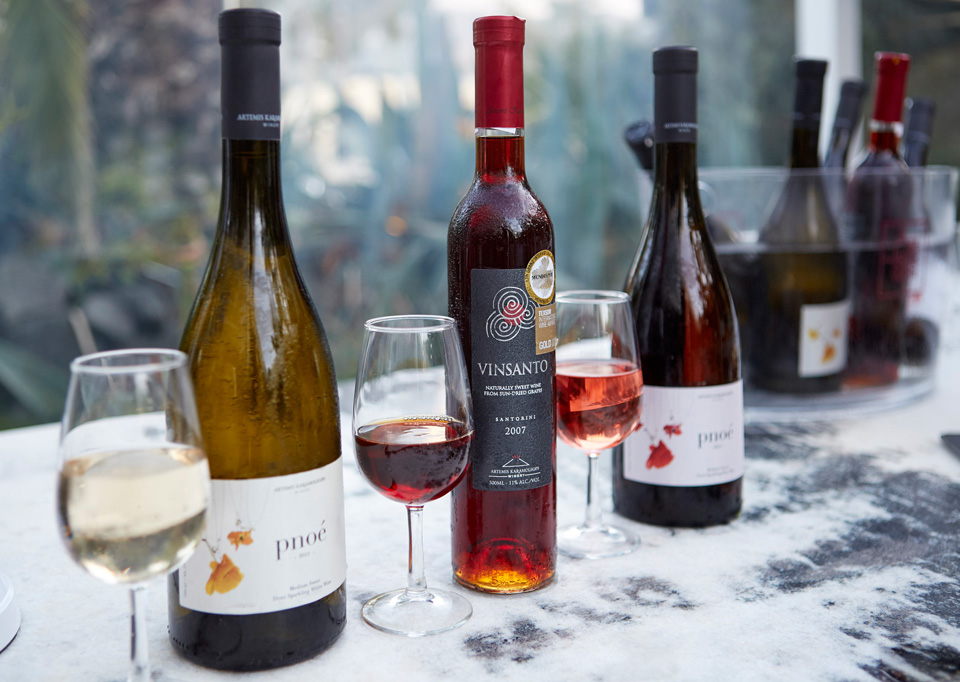
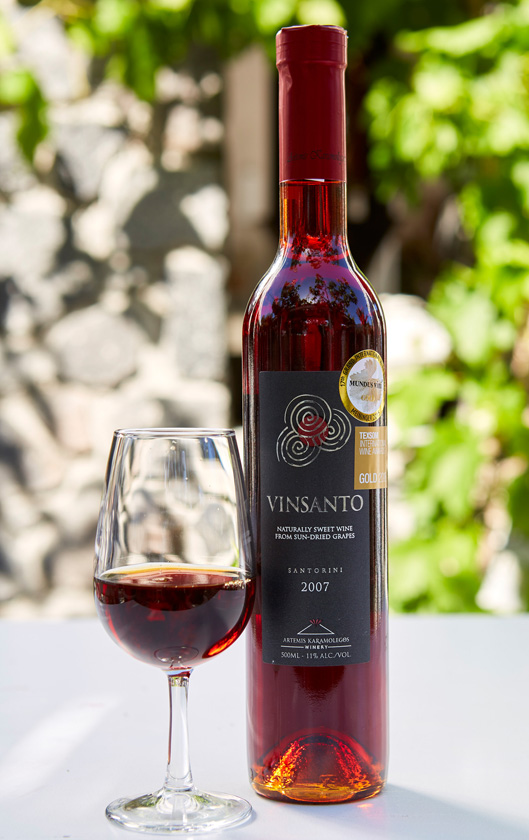
Artemis oversees the renewal of the old vineyard. He plants rare traditional Santorini varieties of grape such as Assyrtiko, Aidani and Mavrotragano. He starts selling the winery’s first bottled wines, Santorini, Nykteri and Vinsanto, on the local market
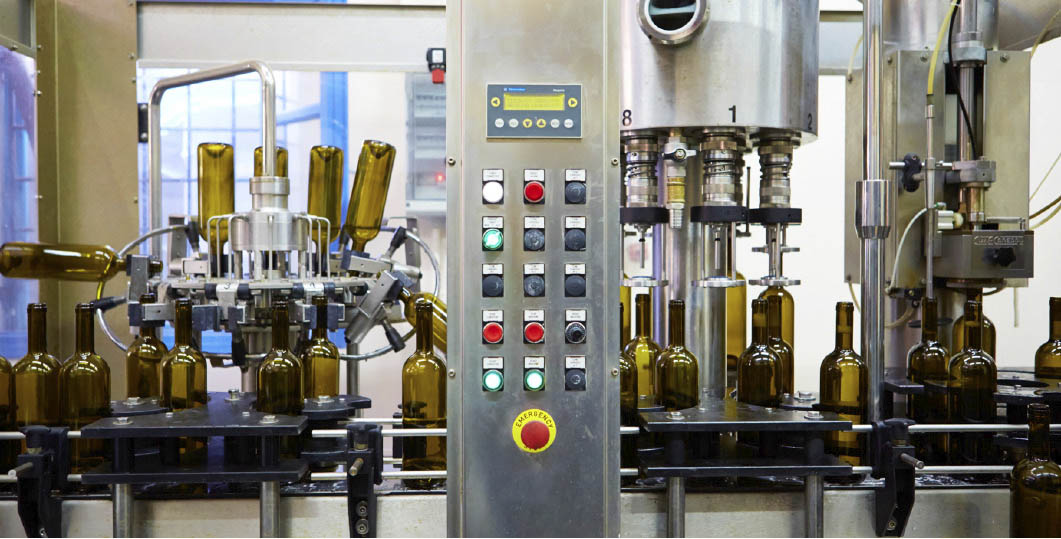
2005 :The winery in Exo Gonia is expanded to house the entire wine production and bottling line including wine presses, fermentation and maturation tanks, vinificators, stabilisers, coolers, filters and pumps. A new label is added to the winery's range, the red Terra Νera.
He redesigns the labels for the existing wines and changes the name of the winery from San…Torini Winery to Artemis Karamolegos Winery. Artemis launches five more new wines on the market: Assyrtiko, Assyrtiko Barrel Aged, white and rosé Terra Nera and Mavrotragano. He also starts to distribute these wines throughout Greece and wines are exported to America, England, Germany, Belgium, Switzerland and Holland.
2008 : The
Artemis Karamolegos Winery opens to visitors.
The
winery starts to export wines to China. Artemis’ wines win many international awards.
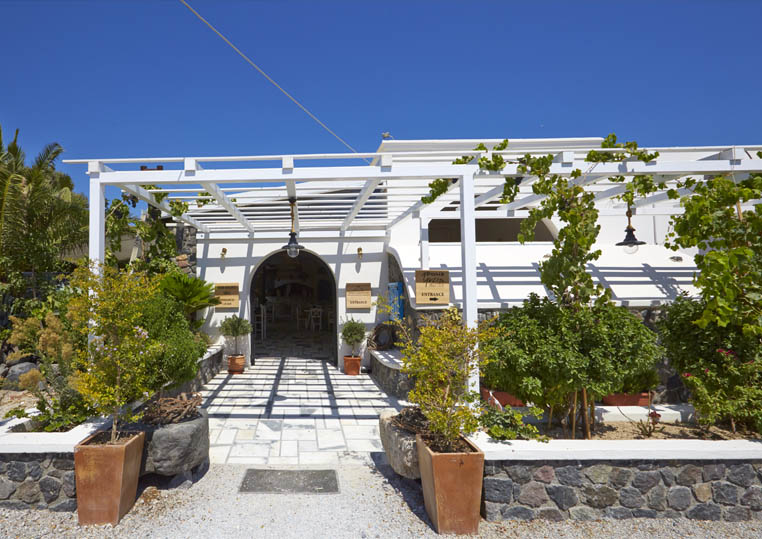
2014 : Wine-tastings
are held in the winery’s new cellar which was built in 2013. The winery’s
partnership with Foodrinco begins, and wines from the winery are distributed
throughout Greece. The Aroma Avlis restaurant opens, and diners can enjoy its
wonderful yard filled with scents from aromatic Greek plants, or relax in the
stylish modern décor of the restaurant’s interior. The restaurant serves
Mediterranean and local cuisine, and also has a shop selling select local
products and wine from the winery.
Artemis Karamolegos’s wines become the wine of choice for many, and their reputation grows and grows. With the guided tours of the winery, the wine tastings, the food in the Aroma Avlis, the cooking lessons and the exhibitions, the winery is brimming with life all day long. The restaurant’s second yard, with a view of the vineyards and the Aegean Sea, also opens at this time. The experience offered by a visit to the Artemis Karamolegos winery is complete.
2016: The
distinctions continue: Gold Medal for Vinsanto 2007 at Mundus
Vini 2016 and TEXSOM IWA 2016, Silver Medal for Assyrtiko 2015 at the same
competitions and Silver Medal for Santorini 2015 at Mundus Vini. Investment in
human resources as Lefteris Anagnostou, Viticulturist-Winemaker, becomes member
of the team.
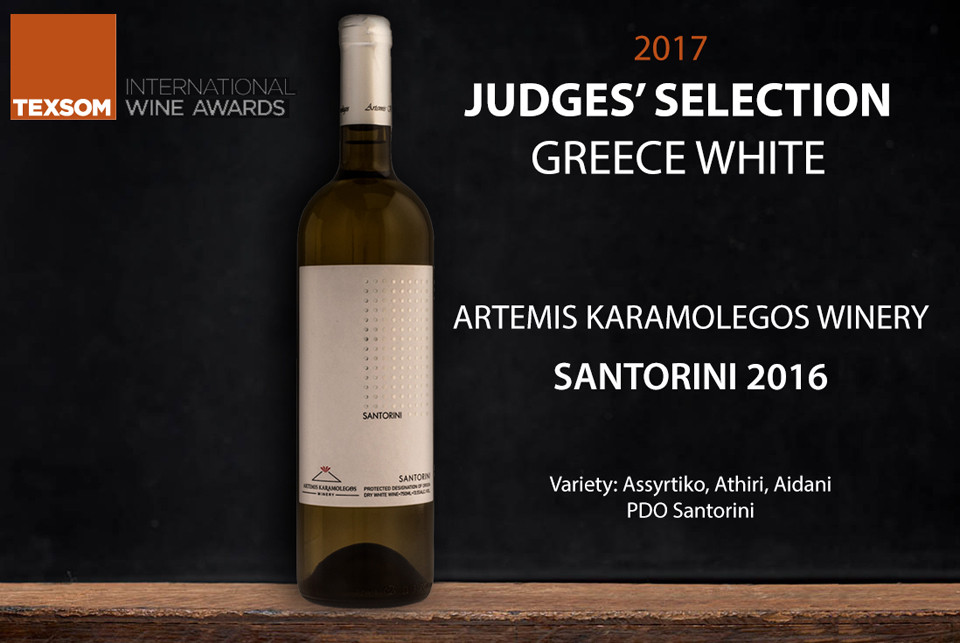
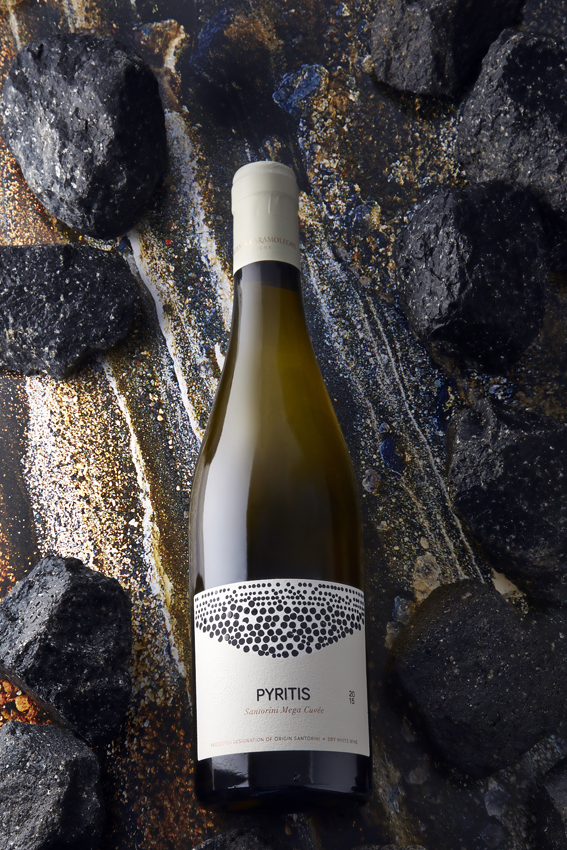
Pyritis' first vintage is released. The premium wine receives excellent reviews and important distinctions. An historic moment for the Winery: Santorini 2016 receives the Judges' Selection award as the best Greek white wine at the TEXSOM IWA 2017. Beside this highest distinction,the winery receives the Gold Medal for Assyrtiko 2016 at the same competition.